

In an era dominated by voice-to-text and predictive AI, the resurgence of the glass pen in 2026 feels less like a trend and more like a necessary grounding ritual. There is something distinctly deliberate about dipping a hand-blown writing instrument into a bottle of ink. Unlike a ballpoint that you can mindlessly drag across a page, a glass dip pen demands your attention. It forces a slower pace, rewarding patience with lines that possess character and shading impossible to replicate with digital tools. For the artist, the calligrapher, or the dedicated bullet journaler, these instruments offer a mechanism that is surprisingly simple yet functionally superior for specific tasks, particularly when working with high-maintenance inks.
The appeal isn’t just aesthetic, though the visual of a spiral glass tip holding suspended liquid is undeniable. The utility lies in the physics. A glass pen eliminates the complex feed systems of fountain pens, meaning there are no hidden channels to clog with glitter or heavy pigments. It is the ultimate tool for testing colors and utilizing the wildest, most shimmer-heavy artisan stationery supplies on the market. Understanding how to wield one effectively requires leaving behind the muscle memory used for gel pens and embracing a technique based on fluid dynamics and light pressure.
The Physics of the Spiral Nib
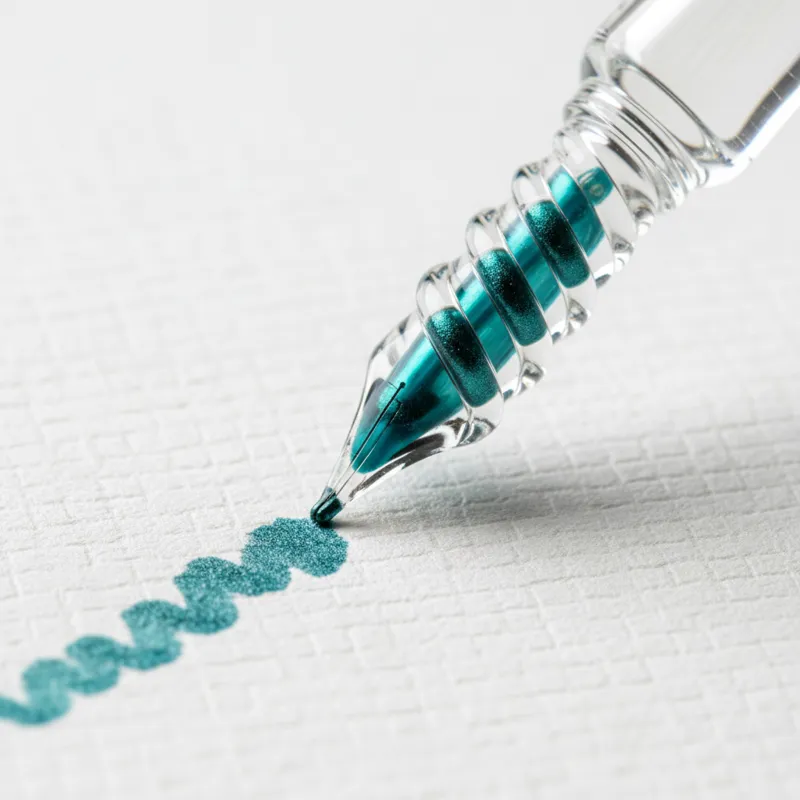
To understand why a glass pen writes the way it does, you have to look at the grooves. A standard metal dip nib uses a split tine to draw ink down to the paper. A glass pen, however, relies entirely on capillary action stored within spiral or straight flutes twisted around the nib’s axis. When you dip the pen, surface tension holds the ink in these narrow channels.
As the tip touches the paper, the fibers of the page break that surface tension, pulling the ink out of the grooves and onto the surface. This mechanism allows for a surprisingly long writing duration per dip. A well-made glass nib can write a paragraph or more before needing a refill. Because there are no moving parts—no tines to spread or feed to regulate air—the line width remains consistent regardless of writing speed, determined solely by the angle of the tip and the grit of the glass finish.
This structural simplicity gives the glass pen its primary advantage: chemical neutrality. Glass is non-porous and non-reactive. You can dip it into iron gall ink, acrylic drawing ink, or even bleach (for negative calligraphy), and it will rinse clean in seconds without corrosion. This makes it the standard-bearer for anyone managing a large collection of bottled drawing ink.
Choosing Your Instrument: What Matters
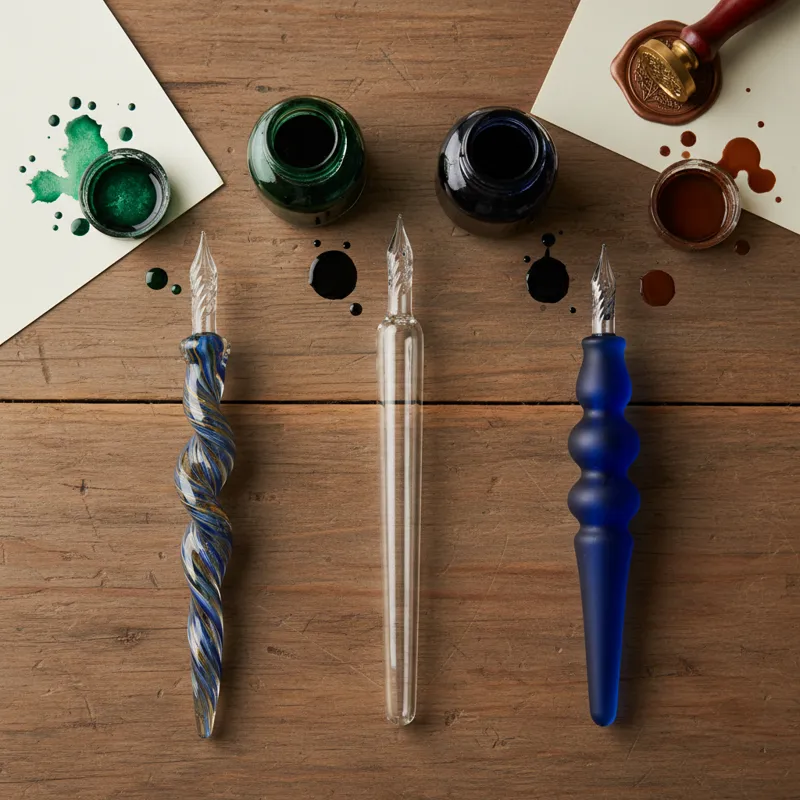
Not all glass pens perform equally. The market in 2026 is flooded with options ranging from mass-produced budget sticks to artisan hand-blown writing instruments. When selecting a pen, look past the handle design and focus intently on the nib.
The Groove Structure
The flutes (grooves) should be deep and consistent. Shallower grooves hold less ink, forcing you to dip more frequently. You generally see two types of twists:
- Tight Spiral: Holds more ink due to increased surface area but can be harder to clean if the ink dries.
- Straight/Gentle Twist: Flows faster and cleans instantly, but runs out of ink quicker.
For most general writing and journaling, a medium twist offers the best balance. It controls the flow enough to prevent huge blobs of ink from hitting the page immediately after dipping.
The Tip Shape
The very tip of the glass nib determines your line width. Unlike fountain pens where “Fine” or “Broad” is stamped on the metal, glass pens vary based on the artisan’s grinding. A rounded, ball-like tip produces a broad, wet line suitable for headers and filling space. A sharper, tapered point offers a hairline stroke perfect for sketching or fine writing. Be aware that sharper points are more fragile and can feel “scratchy” on textured paper.
Operational Technique: How to Write Properly
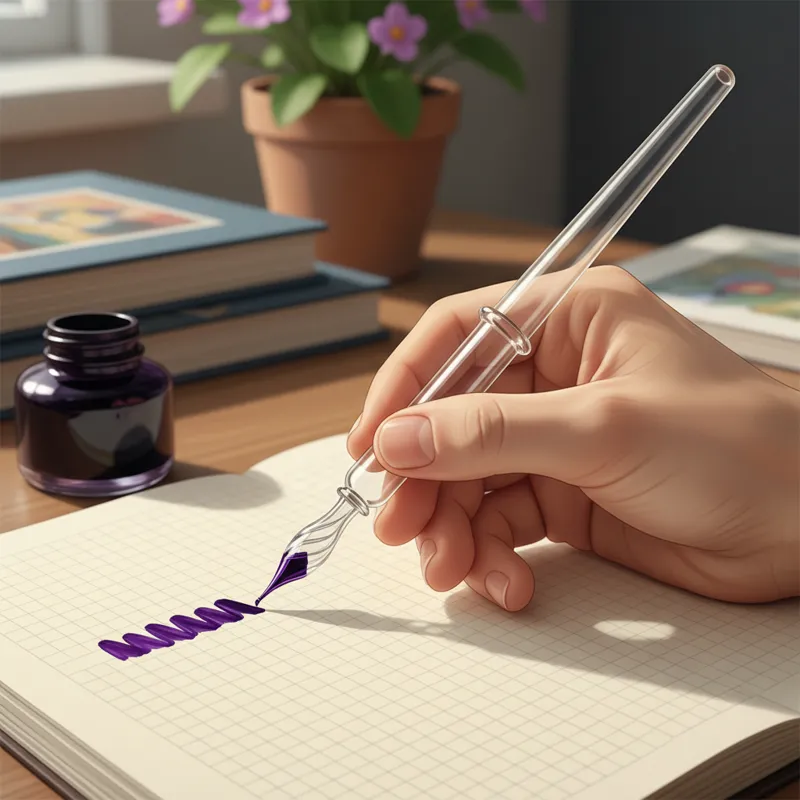
Transitioning to a glass pen requires adjusting your grip and movement. If you press down as you would with a ballpoint, you risk snapping the tip. The glass pen requires zero pressure; the ink flows simply by touching the paper.
The Angle of Attack
Hold the pen at an angle between 45 and 60 degrees relative to the paper. If you hold it too vertically, the ink flows too fast and pools. If you hold it too low, the glass shaft may hit the paper before the tip, breaking the capillary connection.
The Rotation (The Secret Sauce)
This is the nuance most beginners miss. As you write, the ink drains from the specific groove touching the paper. To maintain a consistent wet line, you should slightly rotate the barrel of the pen in your fingers every few sentences. This brings a fresh, ink-filled groove into contact with the paper. This rotational habit extends your writing time significantly and ensures the color density remains uniform from the start of the sentence to the end.
Ink Viscosity Management
Glass pens are agnostic regarding ink types, but viscosity changes the experience. Watery dye-based inks will flow fast and may feather on cheap paper. Thicker acrylics or shimmering particulate inks sit beautifully on the page. If you enjoy the visual depth of a coffee brown design palette in your journal, a glass pen allows you to swap between those earthy sepia tones and metallic highlights instantly without flushing a converter.
Maintenance: Cleaning and Polishing
One of the strongest arguments for owning a crystal calligraphy dip set is the ease of maintenance. Cleaning takes roughly five seconds: swish the tip in a jar of water and wipe it with a paper towel or microfiber cloth. That is it. There is no disassembly required.
Smoothing a Scratchy Nib
Occasionally, a glass pen may feel scratchy or catch on paper fibers. This usually means the tip has a microscopic burr or is slightly uneven. Unlike steel nibs, you can tune this yourself with minimal risk using fine-grit sandpaper (2000 to 12000 grit).
Think of this process like grinding coffee; just as there are specific ways to brew coarse ground coffee that rely on the precise texture of the bean, smoothing a glass nib requires finding the right “grit” for the glass. Gently draw figure-eights on the sandpaper with the inked pen (ink acts as a lubricant). Rotate the pen constantly to ensure an even roundness. Check your progress on regular paper every few seconds. You are essentially polishing the glass, not grinding it down.
Why Glass Pens Dominate Ink Testing
In 2026, the stationery community is obsessed with “shimmer” and “sheen” inks—formulas containing suspended mica particles or high dye concentrations. Putting these in a $300 fountain pen is risky; the particles can clog the microscopic fins of the feed, requiring a tedious disassembly to fix. This is a known issue discussed in communities like the Fountain Pen Network.
A glass pen has no feed. The particles sit in the open grooves and flow directly to the paper. If the ink dries on the glass, re-wetting it dissolves the blockage immediately. This makes the glass pen the industry standard for creating “swatch cards”—cataloging your ink collection. You can dip, swatch a color, rinse, and switch to the next color in under 20 seconds.
What Most People Get Wrong
Even smart users make avoidable errors that shorten the lifespan of their vintage dipping stylus. Here are the practical realities often overlooked:
- The “Tap” Habit: Users accustomed to brushes often tap the tool on the rim of the water jar to shake off excess liquid. Do this with a glass pen, and you will chip the tip. Always wipe, never tap.
- Ignoring Paper Quality: Glass is hard. If you write on extremely rough handmade paper, you will eventually wear down the polish on the tip, making it scratchy. Smooth papers like Tomoe River or varying high-GSM coated papers are ideal.
- Storage Orientation: Never store a glass pen tip-down in a pencil cup. The weight of the pen resting on the delicate point will eventually cause a micro-fracture. Store them horizontally or in a dedicated case.
The Modern Aesthetic: Journaling in 2026
The glass pen fits seamlessly into the “slow living” movements prevalent today. The act of setting up your writing space—opening the ink, placing the pen rest, and dipping the nib—creates a mental boundary between work and reflection. It pairs perfectly with the secrets of the Ministry of Coffee for a morning ritual; the steam of the cup and the scratch of the glass on paper offer a sensory grounding that digital tablets cannot replicate.
Furthermore, the visual aspect of the tool itself serves a purpose. Content creators and artists utilize the transparent nature of the glass to show the ink color traveling down the instrument, adding a layer of visual satisfaction (ASMR) to their process videos. It turns the act of writing into a performance art.
Understanding the Limitations
Honesty is vital here: a glass pen is not a replacement for a daily carry pen. It is not portable in the traditional sense. While travel caps exist, the risk of breakage is high. It is a desk tool. Additionally, it does not offer line variation through pressure (flex) like a steel calligraphy nib. If you push hard to get a thicker line, you will simply break the glass.
The ink capacity, while impressive for a dip pen, is still limited. You cannot write a novel in a coffee shop without bringing a bottle of ink with you, which is a recipe for a spill. According to the Smithsonian’s history of writing instruments, the evolution toward reservoir pens was driven specifically by this inconvenience. However, for intended bursts of writing—letters, journal entries, art—the trade-off is worth it for the ease of cleaning and ink variety.
People Also Ask (FAQ)
Are glass pens just for calligraphy?
No. While they are sold as a crystal calligraphy dip set, most possess a monoline tip (uniform width) that is better suited for regular handwriting, drawing, and bullet journaling than traditional calligraphy scripts like Copperplate or Spencerian.
How fragile are they really?
They are glass. If you drop one on a hardwood floor or tile, it will shatter. However, they are generally made of borosilicate (similar to Pyrex), making them robust enough to handle normal handling and desk use. If you treat it like a wine glass, it will last for decades.
Can I use left-handed techniques with a glass pen?
Absolutely. Because the nib is radially symmetrical (round with grooves on all sides), it does not have a “sweet spot” like a fountain pen. Left-handed writers often find glass pens easier to use because they can write at any angle without scratching or digging into the paper.
Why is my ink dripping too fast?
This is usually due to dipping the pen too deep. You only need to submerge the spiral tip, not the handle. If you dip past the throat of the pen, a large drop forms that gravity will pull down instantly. Wipe the excess gently on the rim of the bottle before writing.
Can I repair a broken tip?
If the break is minor (just the very tip snapped off), you can grind it down using the sandpaper method mentioned earlier to create a broader, stub-like nib. If the spiral itself is shattered, the pen is essentially ruined for writing, though it remains a beautiful object. The Museum of Glass often showcases how cold-working glass can alter its shape, and similar principles apply here on a micro scale.
The glass pen remains a testament to the idea that the newest technology isn’t always the best tool for the job. In 2026, where efficiency is automated, the glass pen offers permission to be inefficient, tactile, and colorful. It allows you to explore the chemistry of fluids and the texture of paper in a way that connects you deeply to your words.


