The chai tea latte has become a cornerstone of American café culture, a comforting blend of black tea, aromatic spices, and creamy milk. It’s the go-to order for millions who want warmth and flavor without the intense jolt of espresso. But as we’ve all become more conscious of what we consume, a critical question often surfaces right before ordering: Just how many calories are in a chai tea latte? The answer, unfortunately, isn’t straightforward. A chai latte can range from a reasonably light, spiced beverage to a dessert-in-a-cup that rivals a milkshake in sugar content. Understanding the difference comes down to knowing what’s in your cup and how it’s made.
What’s Actually in a Chai Tea Latte? The Core Components

Before we can dissect the calorie count, we need to understand the building blocks. A chai latte isn’t a single, defined product; it’s an assembly of parts, and each part has nutritional implications. At its heart, it’s a Westernized interpretation of masala chai, a traditional Indian beverage.
Here’s the typical anatomy of the chai latte you’d buy at a coffee shop:
- Chai Concentrate: This is the most significant variable and the primary source of calories and sugar in most commercial chai lattes. It’s a pre-brewed, sweetened, and spiced liquid that shops mix with milk. It’s designed for speed and consistency, but that convenience comes at a nutritional cost. The sweetener is almost always a form of sugar (cane sugar, corn syrup, or honey).
- Milk: The second major component. The default is typically 2% dairy milk, but the choice of milk—from skim to whole, or plant-based alternatives like almond, soy, or oat—is one of the biggest levers you can pull to change the final calorie count.
- Spices: The soul of chai. This classic blend usually includes cinnamon, cardamom, cloves, ginger, and black peppercorns. On their own, these spices contribute negligible calories but are packed with beneficial compounds.
- Tea: The foundation is a robust black tea, typically an Assam or Ceylon variety. Like the spices, the tea itself contributes virtually zero calories.
The key takeaway is that the high calorie count in a typical chai latte doesn’t come from the tea or spices. It’s almost entirely driven by the two main liquids: the pre-sweetened concentrate and the milk.
The Calorie Breakdown: A Look at Major US Coffee Chains
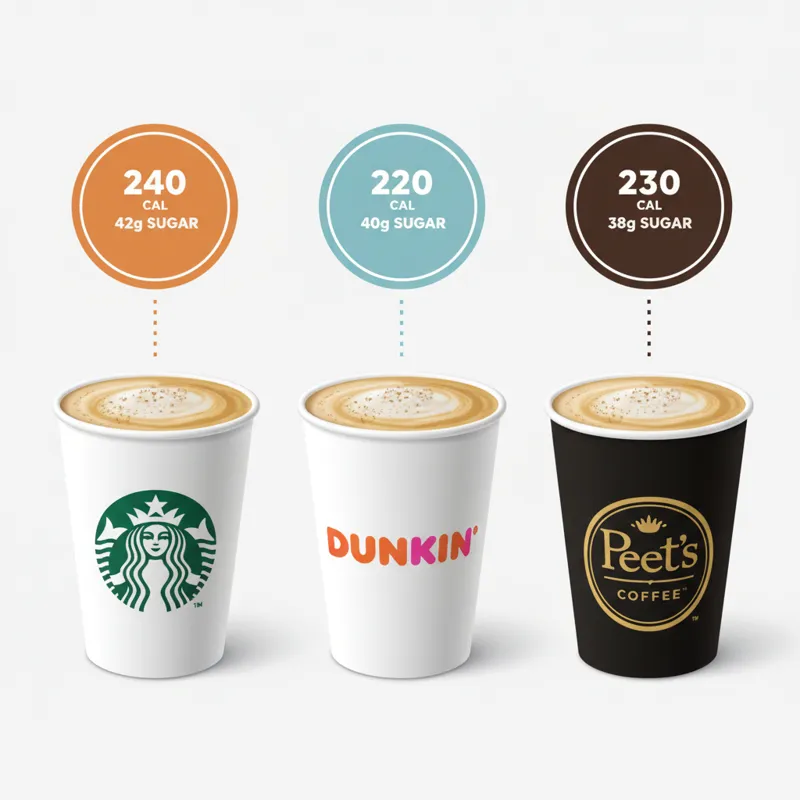
To get a real-world sense of chai tea latte calories, let’s look at the numbers from the places most Americans get their fix. The data below is based on a standard “Grande” (16 oz) size with the default 2% milk, reflecting what a customer receives if they don’t make any modifications. These numbers are representative for 2026 but always check the company’s official nutritional information for the most current data.
Starbucks Chai Latte Nutrition Facts (Grande, 16 oz, 2% Milk)
- Calories: Approximately 240
- Fat: 4.5g
- Carbohydrates: 45g
- Sugar: 42g
- Protein: 8g
The sugar content here is striking. At 42 grams, you’re consuming the equivalent of 10.5 teaspoons of sugar. This comes almost entirely from the heavily sweetened chai concentrate that Starbucks uses.
Dunkin’ Chai Latte (Medium, 16 oz, Whole Milk default)
- Calories: Approximately 340
- Fat: 9g
- Carbohydrates: 55g
- Sugar: 53g
- Protein: 9g
Dunkin’s version, using whole milk as the standard, is even higher in calories and sugar. The 53 grams of sugar are equivalent to over 13 teaspoons, placing it firmly in the “liquid dessert” category.
Peet’s Coffee Chai Latte (Medium, 16 oz, 2% Milk)
- Calories: Approximately 260
- Fat: 5g
- Carbohydrates: 46g
- Sugar: 43g
- Protein: 9g
Peet’s falls right in line with Starbucks, again demonstrating that the industry standard for a chai latte is a high-sugar beverage. The culprit is always the same: a pre-made liquid base that prioritizes sweetness and convenience over nutritional transparency.
The Milk Matrix: How Your Choice Dramatically Alters Calories
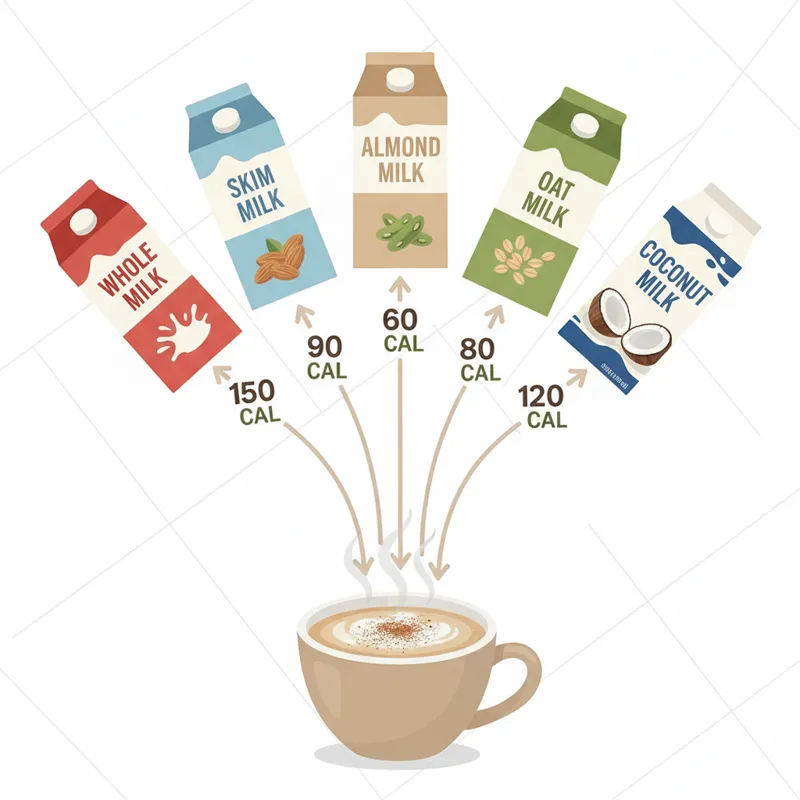
While you can’t control the sugar in the concentrate, you have complete control over your milk choice. This is where you can make a significant dent in the total calorie count. Let’s use the Starbucks Grande Chai Latte as a baseline (which has about 120 calories from the concentrate alone) and see how swapping the milk changes the final numbers.
Here’s a breakdown of how a 16 oz chai latte’s calories change based on milk. These estimates use widely available nutritional data for milk from sources like the USDA FoodData Central.
- Whole Milk: Adds ~150 calories. Total: ~270 calories.
- 2% Milk (The Standard): Adds ~120 calories. Total: ~240 calories.
- Nonfat (Skim) Milk: Adds ~80 calories. Total: ~200 calories.
- Soy Milk (Sweetened): Adds ~130 calories. Total: ~250 calories.
- Oat Milk: Adds ~140-160 calories. Total: ~260-280 calories.
- Unsweetened Almond Milk: Adds ~30-40 calories. Total: ~150-160 calories.
The difference is dramatic. Simply switching from 2% milk to unsweetened almond milk can save you 80-90 calories per drink. Opting for nonfat milk saves about 40 calories. On the other hand, choosing oat milk, which has become incredibly popular for its creamy texture, can actually add more calories than 2% dairy milk. The calories in chai with almond milk, specifically the unsweetened variety, make it the clear winner for anyone aiming for the lowest possible calorie count in a coffee shop.
The Sweetener Situation: Unmasking the Hidden Sugar
We need to talk more about the sugar. The question of “how much sugar in a chai latte?” is arguably more important than the calorie count. The 40-50+ grams of sugar found in a typical 16 oz serving is the most concerning nutritional aspect.
The American Heart Association recommends no more than 36 grams of added sugar per day for men and 25 grams for women. A single medium chai latte from virtually any major chain can exceed that entire daily limit.
Why so much? The concentrate is formulated to be intensely sweet to stand up to the dilution from milk and ice. Unfortunately, this means you can’t order an “unsweetened” chai latte at most places. The sugar is already baked in. If you ask for a “skinny” or “light” version, the barista will typically just swap the 2% milk for nonfat milk. This reduces calories but does absolutely nothing to lower the high sugar content from the concentrate itself.
The only true way to get a low-sugar chai drink at a coffee shop is to bypass the latte format entirely. You can order a brewed chai tea (from a tea bag) and ask for a splash of your preferred milk and add a sugar-free sweetener yourself. This gives you all the spiced flavor with a tiny fraction of the calories and sugar.
What Most People Miss: The “Dirty” Chai and Other Modifications
The customization doesn’t stop with milk. A few popular modifications can further alter the nutritional profile of your chai latte, for better or worse.
The “Dirty” Chai Latte
A “dirty” chai is simply a chai latte with a shot (or two) of espresso added. It’s a popular choice for those who want the spiced flavor of chai but the caffeine kick of coffee. Nutritionally, a shot of espresso adds only about 5 calories and no sugar, making it a nearly negligible change to the total. It doesn’t make the drink “healthier,” but it certainly doesn’t make it worse.
The Calorie Bombs: Whipped Cream and Syrups
Where you can quickly get into trouble is with other additions. Adding whipped cream to a 16 oz chai latte can tack on an extra 80-120 calories and several grams of fat and sugar. Adding a pump or two of a flavored syrup, like vanilla or pumpkin spice, can add another 20-40 calories and 5-10 grams of sugar per pump.
A Grande Chai Latte with whipped cream and two pumps of vanilla syrup can easily surpass 350 calories and 60 grams of sugar, pushing it far beyond a simple beverage and into the realm of a decadent dessert.
Crafting the Perfect Low-Calorie Chai Latte at Home
The best way to control your chai tea latte calories is to make it yourself. It’s surprisingly simple and gives you complete authority over every ingredient. You can create a delicious, creamy drink for under 50 calories. This is the ultimate “skinny chai latte recipe” because you build it from the ground up.
Step 1: Choose Your Chai Base (The Flavor Engine)
- Easiest Method (Tea Bags): Steep 1-2 chai tea bags in about 4-6 ounces of hot water for at least 5 minutes. The longer you steep, the more intense the flavor. This base has 0 calories.
- DIY Spice Blend: For the best flavor, gently toast whole spices (a cinnamon stick, a few cloves, cardamom pods, black peppercorns) in a dry saucepan until fragrant. Add water and a black tea bag and simmer. This is also 0 calories.
- Low Calorie Chai Concentrate: The market for unsweetened or lightly sweetened chai concentrates has grown. Look for brands that explicitly state “unsweetened” on the label. Brands like Tazo and Oregon Chai offer these versions. This gives you coffee shop convenience without the sugar overload.
Step 2: Pick Your Milk (The Body)
As we saw, this is critical. For the lowest calorie count, use 8-10 ounces of unsweetened almond milk (~30-40 calories). For a creamier but still low-calorie option, use nonfat milk (~60-70 calories). Unsweetened soy or coconut milk are also great options. The simple act of steeping your tea is a perfect short break, a moment to check your phone and ponder things like if your Audible credits are about to expire.
Step 3: Select Your Sweetener (The Finish)
Here’s where you have total freedom. Instead of 40+ grams of sugar, you can add exactly what you want.
- Zero-Calorie: A few drops of liquid stevia, a packet of monk fruit sweetener, or a teaspoon of erythritol will give you sweetness with no calories or sugar.
- Lower-Calorie Natural: One teaspoon of pure maple syrup or honey adds about 20 calories and 5 grams of sugar—a massive improvement over the coffee shop version.
Combine your brewed chai base, your steamed or frothed milk, and your sweetener of choice. You’ve just made a delicious, comforting chai latte for a fraction of the calories and cost. This kind of simple, satisfying ritual can make any home feel as comforting as a bed and breakfast, perhaps even one as renowned for its hospitality as the historic White House Inn.
A Quick-Reference Calorie Guide (Chart)
To put it all together, here’s a simple comparison for a 16 oz (Grande/Medium) chai latte.
| Drink Version | Approx. Calories | Approx. Sugar (g) | Key Calorie/Sugar Driver ||—|—|—|—|| Coffee Shop Standard (2% Milk) | 240 – 340 | 42 – 53g | Pre-sweetened concentrate || Coffee Shop “Skinny” (Nonfat Milk) | 200 – 300 | 42 – 53g | Pre-sweetened concentrate || Homemade (Unsweetened Almond Milk & Stevia) | 40 – 50 | 1g | Milk (almond) |
The visual contrast is clear. The problem isn’t the “chai latte” as a concept; it’s the specific, high-sugar formulation used for speed and consistency in a commercial setting. The complex and inviting aroma of the spices in a well-made chai, from cinnamon to cardamom, is a sensory experience, much like appreciating a finely arranged bouquet from a skilled artisan such as Ramos Flowers.
Frequently Asked Questions
Is a chai tea latte healthy?
It completely depends. A standard coffee shop chai latte is high in sugar and calories, making it more of an occasional treat than a healthy daily beverage. However, a homemade version using brewed tea, unsweetened plant-based milk, and a zero-calorie sweetener can be a very healthy, low-calorie option filled with beneficial spices.
How many calories are in a Starbucks Venti Chai Latte?
A Venti (20 oz) Hot Chai Tea Latte with 2% milk from Starbucks contains approximately 300 calories and 53 grams of sugar. The iced version is larger (24 oz) and, with standard preparation, contains around 350 calories and 68 grams of sugar due to the larger volume of milk and concentrate.
Can I get an unsweetened chai latte at a coffee shop?
Usually, no. Because most chains use a pre-sweetened liquid concentrate, the sugar cannot be removed. Your best alternative is to order a brewed chai tea (made with a tea bag) and ask them to add steamed milk, which they will serve you on the side or add for you. You can then add your own preferred sweetener.
Does a chai latte have more calories than a regular latte?
Often, yes. A standard Grande Caffè Latte from Starbucks with 2% milk has about 190 calories and 18 grams of sugar (from the milk). The Grande Chai Latte has 240 calories and 42 grams of sugar. The extra calories and, more significantly, the massive amount of added sugar come directly from the chai concentrate.